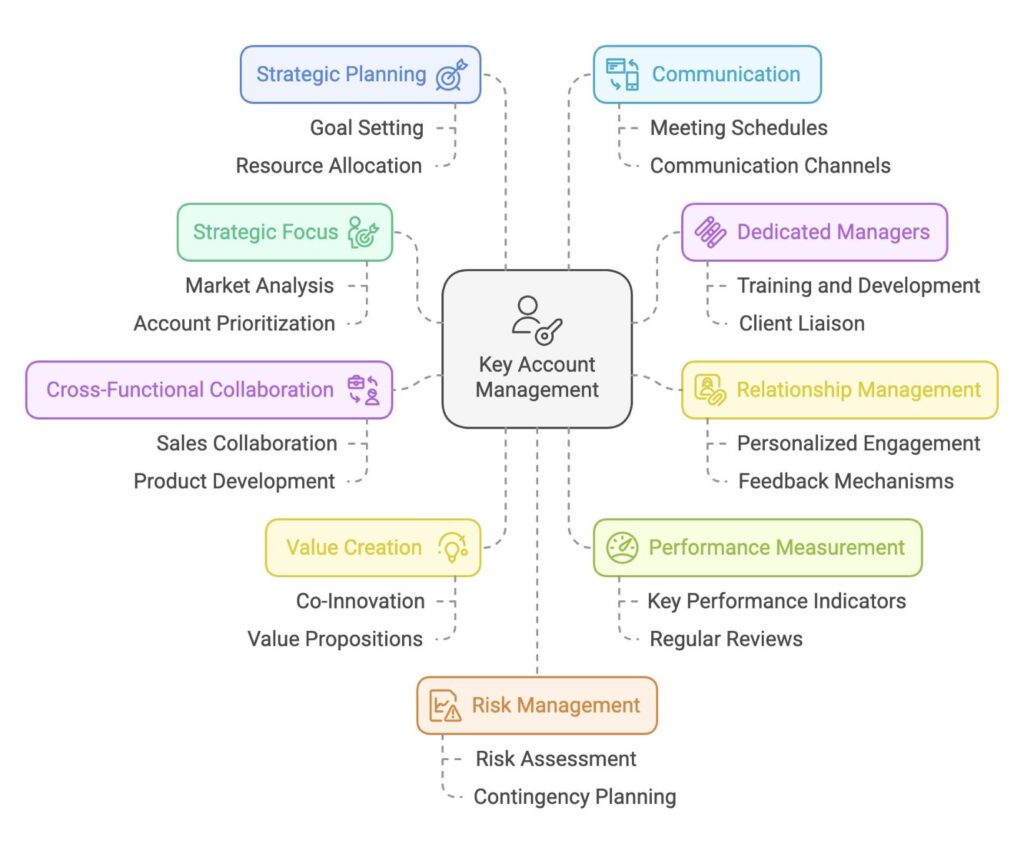
Key Account Management (KAM): The Complete Strategic Guide to Growing Your Most Valuable Clients
1. What is Key Account Management?
Key Account Management (KAM) is a structured, strategic approach to managing an organisation’s most valuable customers—those that drive disproportionate revenue, profit, or long-term strategic value.
At its highest level, KAM is not about servicing accounts—it is about engineering growth, defending revenue concentration risk, and creating mutual long-term value.
Who this is for:
- Senior Account Managers
- Sales Directors
- Commercial Leaders
- Business Unit Heads
Who this is NOT for:
- Transactional sales roles
- Short-cycle, low-value customer environments
2. Why Key Account Management Matters
In most B2B organisations:
- 20% of customers generate 70–80% of revenue
- Losing one key account can destroy annual targets overnight
- Over-servicing low-value accounts quietly erodes profitability
KAM exists to:
- Protect revenue concentration
- Maximise lifetime value
- Create strategic partnerships—not just supplier relationships
3. Identifying Your Key Accounts (Beyond Revenue)
Most companies get this wrong.
They define key accounts as:
“Our biggest customers by revenue”
That is incomplete—and dangerous.
A Better Model: 4-Dimensional Account Scoring
Evaluate accounts based on:
- Revenue Contribution
- Profitability (Margin after cost-to-serve)
- Strategic Value (market access, brand, influence)
- Growth Potential
👉 The output should be a ranked portfolio, not a subjective list.
4. The Economics of Key Accounts (Where Most Articles Fail)
This is the single biggest gap in current online content.
You must understand:
Customer Lifetime Value (CLV)
Total profit expected from an account over time.
Cost-to-Serve
Hidden costs:
- Customisation
- Support burden
- Management time
- Payment delays
Margin Leakage
Accounts that look large—but are barely profitable.
Key Insight:
Not all “big accounts” are good accounts.
A world-class KAM system actively:
- Invests in high-margin growth accounts
- Restructures or exits low-value ones
5. The KAM System (End-to-End)
A high-performing KAM function operates as a system, not a role.
Stage 1: Selection
Identify true key accounts using scoring
Stage 2: Insight Development
Understand:
- Customer strategy
- Market position
- Internal pressures
Stage 3: Strategy Creation
Define:
- Growth objectives
- Relationship strategy
- Competitive positioning
Stage 4: Execution Planning
Translate strategy into:
- Actions
- Owners
- Timelines
Stage 5: Review & Optimisation
Continuous performance tracking and adjustment
6. Building a Strategic Account Plan
A real account plan is not a document—it is a decision-making tool.
Include:
- Account overview (structure, financials)
- Market and competitor analysis
- Stakeholder map
- Growth opportunities
- Risk analysis
- 12–24 month revenue roadmap
7. Stakeholder Mapping & Power Dynamics
Most deals are not won or lost on value—they are won or lost on influence.
Map:
- Decision-makers
- Influencers
- Gatekeepers
- Blockers
Analyse:
- Power vs interest
- Alignment vs resistance
Build:
- Multi-threaded relationships (never single contact dependency)
8. Growth Strategy for Key Accounts
Move from selling products → creating value.
Core Growth Levers:
- Cross-selling adjacent solutions
- Upselling higher-value offerings
- Co-creating solutions with the client
- Embedding into their strategy
9. Governance & Operating Rhythm
Without structure, KAM collapses into reactive firefighting.
Implement:
- Quarterly Business Reviews (QBRs)
- Monthly internal account reviews
- Executive sponsorship alignment
- Clear escalation pathways
10. Metrics That Actually Matter
Most companies track the wrong things.
Track:
- Revenue growth (per account)
- Profitability (not just revenue)
- Share of wallet
- Retention risk indicators
- Strategic objective progress
11. Common Failure Points
- Treating all large accounts as “key”
- Over-servicing low-margin clients
- Lack of internal alignment
- Reactive account management
- Single-threaded relationships
12. Industry-Specific Approaches
Government / Public Sector
- Long procurement cycles
- Relationship continuity critical
Oil & Gas
- High-value contracts
- Risk and compliance dominant
Telecoms
- Complex stakeholder ecosystems
- Technology-driven differentiation
Professional Services
- Trust and expertise as primary value drivers
To truly outperform competitors, provide:.
13. The Future of Key Account Management
KAM is evolving fast.
Emerging Trends:
- AI-driven account insights
- Predictive churn analysis
- Digital relationship mapping
- Data-led personalisation at scale
15. Final Takeaways
- KAM is a strategic growth system, not a sales function
- Profitability matters more than revenue
- Relationships must be multi-layered
- Execution discipline is everything